Ancestry
High Elf
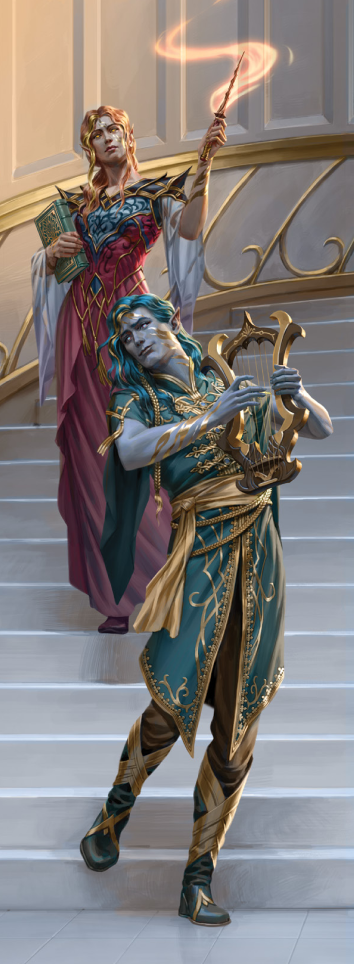
Many high elves hold that they were shaped in the earliest ages by the Aetherim, formed to tend knowledge, preserve craft, and give ordered shape to a world still unfinished. Whether this belief reflects literal creation or later interpretation remains uncertain, yet it continues to frame how high elves understand their origins and responsibilities. They commonly see their lives as part of a long extension of an earlier age, remembered for coherence and continuity. Their oldest surviving accounts dwell on the Age of Song, when art, governance, and memory developed together under Aetherim guidance.
High elves live throughout the Vale alongside other peoples, and only rarely form settlements of their own. When they do gather in number, they gravitate toward sites that carry visible traces of the first age. Ancient halls, towers, and civic structures are preserved and adapted with careful attention to proportion, material, and method. Elven builders draw directly from early models, repeating forms whose origins lie beyond living memory. Craft within this tradition is an act of recollection. Architecture, music, and ornament are treated as continuations of the same discipline, each shaped by patterns first established in the Age of Song.
In the absence of the Aetherim, individual elves have taken on roles once associated with their presence. Many devote their lives to study and transmission, serving as historians, tutors, archivists, or keepers of specialised disciplines within mixed communities. Others pursue artistic or technical callings grounded in older forms, recreating melodies, scripts, and designs whose meaning is preserved through use. Over long spans, this focus draws attention inward. Elven priorities tend to follow long continuity, and their relationships with others reflect patience shaped by extended perspective.
High elven culture places weight on memory and endurance, even when practiced quietly within broader society. Life is approached deliberately, with long periods devoted to a single calling, place, or discipline. Art, lore, and beauty are understood as inherited obligations that require sustained effort to maintain. This work is openly nostalgic in character, shaped by attachment to an age that cannot be restored. It is also regarded as necessary. Through careful repetition and preservation, high elves believe they carry fragments of an older order forward, ensuring that what survives continues to have form and meaning as the world changes around it.
Last updated: 6 June 2026